Cigarette Box Design Template
Table of Contents
-
Industry Context: Why 2025 is different
-
Services & Features for a robust template
-
Scorecard: 12 evaluation points before approval
-
Process (strategy → dieline → prepress → print)
-
Visual System & Hierarchy inside a constrained canvas
-
Compliance & Risk Controls (high-level, non-legal)
-
Print Methods, Materials & Finishes
-
E-commerce Readiness (thumbnail → PDP → unboxing)
-
Sustainability without greenwashing
-
Common Mistakes & Quick Fixes
-
Files, Color & Prepress: what printers need
-
Timelines, MOQs & Cost Levers
-
Hire CTA + Internal Portfolio Links
Industry Context: Why 2025 is different
-
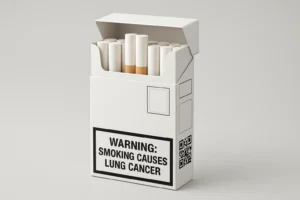
Tighter regulation windows: Health warnings, plain packaging rules, and placement logic vary by market and change frequently. Templates must be modular with locked zones for warnings and tax stamps.
-
Counterfeiting pressure: Serialized QR/UIDs are increasingly common; your template must reserve distinct quiet zones and tamper paths.
-
Omnichannel selling: Even when retail is primary, listings and approvals now require photo-accurate proofs and 3D previews.
-
Sustainability scrutiny: Less lamination, recyclable boards, and credible disposal guidance—no vague “eco” claims.
-
Rapid varianting: Flavors/strengths/size packs require color governance and pattern systems that stay consistent at ΔE ≤ 2.0.
Services & Features for a Robust Template
-
Master CAD dieline for soft-pack and hinged-lid (flip-top) cartons; optional hard-pack variants.
-
Regulated copy architecture: health warning frames, pictorials, tax stamps, track-and-trace fields, manufacturer/address lines.
-
Color governance: Pantone masters + LAB targets; overprint/knockout rules; trapping 0.08–0.12 mm at ink joins.
-
Anti-counterfeit layer: microtext, UV marks, guilloché, serial QR + human-readable UID, tear tape controls.
-
E-comm readiness: thumbnail legibility at 120–160 px; hero angle consistency; on-white compliant images.
-
Sustainability options: FSC FBB/SBS, water-based coatings, mono-material thinking where feasible.
Scorecard: 12 Evaluation Points Before Approval
-
Warning zone compliance (size %, placement, rotation where required).
-
Tax stamp & track-and-trace windows reserved with quiet zones ≥ 2.5 mm.
-
Color control: Pantone + LAB; press proof ΔE ≤ 2.0 to master.
-
Bleeds & safety: bleed ≥ 3 mm, safety 3–5 mm around all critical text.
-
Barcode/QR: location off folds; scannability (ANSI grade A/B).
-
Trapping/overprint: 0.08–0.12 mm; no overprint on small text (≤8 pt) or thin rules.
-
Tamper cues: tear tape direction, “lift/peel” arrows where applicable.
-
Hierarchy: brand marks secondary to legal warnings (where mandated) yet consistent across panels.
-
Material spec: board caliper, stiffness, scuff resistance; foil or metallized film constraints declared.
-
E-comm thumbnails: variant/family legible at 120–160 px.
-
Security features: microtext legibility and UV hit positions pass line trials.
-
Version control: template revision noted on artboard + change log.
Process (Strategy → Dieline → Prepress → Print)
-
Strategy & market matrix
-
Map markets (A/B/C) with warning %, pictorial rotation needs, tax stamp positions, and serialization formats.
-
-
Content architecture
-
Lock all mandatory copy: health warnings, tar/nicotine statements (if required), manufacturer lines, barcodes/UIDs, website/quitline where mandated.
-
-
Master visual system
-
Define category colors/patterns; ensure not dependent on color alone for SKU differentiation.
-
-
Dieline development
-
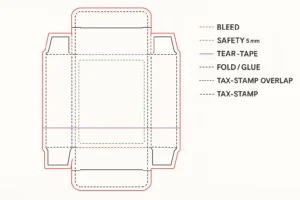
Hinged-lid & soft-pack: establish flaps, hinge panel, top/bottom panels; add 3 mm bleed, 5 mm safety; show wrap direction; reserve tax stamp and tear tape paths.
-
-
Prototypes (white & printed comps)
-
Check warning frame cuts, hinge alignment, stamp overlap, and tear tape behavior.
-
-
Prepress
-
Convert spot colors; build overprint/knockout map; set trapping 0.08–0.12 mm; images at 300 ppi @100%; line art 1200 ppi.
-
Barcodes at spec magnification with quiet zone ≥ 2.5 mm; test scan.
-
-
Security embedding
-
Place microtext (≥0.3 mm cap height), UV hits, guilloché; reserve serialized QR zone and test with actual code lengths.
-
-
Press proof & sign-off
-
Hard proof with ΔE readouts; no approval if over tolerance; sign rich black usage policy (solids only, not small type).
-
-
Line trial
-
Verify folding, tear tape, tax stamp application, and scuff resistance.
-
-
Handover kit
-
Locked PDF/X, source files, color bible, barcode/QR specs, revision log, and photo guidelines for e-comm.
Visual System & Hierarchy Inside a Constrained Canvas
-
Top/Front panel: warning frame dominates where required; brand zone below/aside per regulation.
-
Side panels: ingredients/constituent table (if required), manufacturer address, barcodes/UID, recycling/disposal icons.
-
Back panel: second warning, quitline/website, tax stamp overlap area.
-
Color logic: consistent hue per variant; pair with pattern or alphanumeric code; maintain contrast ≥ 4.5:1 for small text.
-
Iconography: disposal, no-sale age mark, QR/UID symbol, microtext key.
-
Do not crowd folds: keep 6–8 mm clear from folds for small text and codes.
Compliance & Risk Controls (High-Level, Non-Legal)
-
Maintain controlled master copy; record rev codes on artboard and file name.
-
Separate market law layers (A/B/C) for easy toggling; export market-specific masters.
-
Don’t rely on color alone to differentiate variants; add pattern, numeral, or symbol.
-
Keep UID/serialization and tax stamp areas flexible; never place under varnish/foil that reduces readability.
-
Integrate tamper directions if tear tape/induction seals are used.
Note: Guidance only. Always validate with legal/regulatory experts for each jurisdiction.
Print Methods, Materials & Finishes
-
Litho offset on FBB/SBS 260–320 gsm for hinged-lid; soft-pack often uses printed OPP + inner foil wrap (where legal).
-
Finishes: aqueous matte/satin for cleanability; soft-touch sparingly (shows scuffs); spot gloss away from warnings/codes; cold foil only in non-regulated zones.
-
Security: UV invisible inks, microtext, emboss/deboss on tax stamp area if allowed; tamper tear tape alignment marks.
-
Scuff & rub: request scuff tests vs common shipper board surfaces; mandate coating weight ranges.
E-commerce Readiness (Thumbnail → PDP → Unboxing)
-
Thumbnail (120–160 px): variant code + family name readable; warning area visible as required—no misleading crops.
-
PDP gallery (6–8 images): front, side (barcode/UID), top with tax-stamp window, macro of microtext/UV mark, hinge close-up, in-hand scale, flattened dieline.
-
Downloads: market-specific cigarette box design template PDFs/AI with bleed/safety, overprint/knockout legend, barcode/QR placement guide.
-
Unboxing: show tear-tape path and stamp interaction; ensure photos reflect real ΔE to print.
Sustainability Without Greenwashing
-
Prefer FSC-certified boards; right-weight caliper where compression allows.
-
Use water-based coatings over plastic laminations unless barrier is required.
-
Design for mono-material where feasible; avoid mixed lamination combinations that hinder recycling.
-
Provide clear disposal icons applicable to the market; link QR to region-wise guidance.
-
Report real recycled content %; avoid vague claims.
Common Mistakes & Quick Fixes
-
Warning misplacement → Lock a grid with pinned warning frames; use market layer toggles.
-
Barcode on folds → Relocate to flat panel; maintain quiet zone ≥ 2.5 mm; re-grade scan to A/B.
-
Overprint on small type → Force knockout for ≤8 pt text; check in Overprint Preview.
-
Color drift → Use Pantone + LAB; demand press ΔE report; sign one color bible across vendors.
-
Tax stamp clash → Reserve overlap window in dieline; share a stamp jig diagram.
-
Tear tape tearing art → Add unprinted “tape lane” and arrow cues; test with real adhesive.
Files, Color & Prepress: What Printers Need
-
Finals: PDF/X-1a or X-4; fonts outlined; source files archived.
-
Layers (non-printing): dieline, fold, glue, varnish, foil, emboss, white ink, security, warning masks, market A/B/C.
-
Bleed ≥ 3 mm; safety 3–5 mm; avoid minuscule rules near creases.
-
Images 300 ppi; line art 1200 ppi; total ink limit per press profile.
-
Pantone governance: master chips + LAB values; ΔE ≤ 2.0 to approve.
-
Barcodes/QR: magnification & height spec; quiet zone ≥ 2.5 mm; location callouts.
-
Serialization: variable fields tested in RIP; human-readable fallback.
-
Overprint/knockout legend printed on pasteboard with swatches.
Timelines, MOQs & Cost Levers
-
Strategy + market matrix: 3–5 days (faster if matrix pre-exists).
-
CAD + template build: 4–6 days (two pack types).
-
Prepress + security: 3–5 days (proof + UV plate test).
-
Press: digital pilots 3–5 days; offset runs 10–14 days incl. drying & QC.
-
MOQs: digital 100–500 sets (for pilots); offset commonly 5k–20k per SKU.
-
Levers: unify board calipers; limit spot colors; gang-run variants; standardize tax-stamp window and tear-tape geometry across SKUs.
Hire Us + Internal Portfolio Links
Need a compliant, scalable cigarette box design template that prints clean and passes audits? We’ll build your master, lock color/security, and set you up for fast variant launches—bina tension.
-
Label & supplement systems (strict hierarchy discipline):
https://usmandesigner.com/portfolio/supplement-label-design-freelancer/ -
High-fidelity consumer packs & 3D renders:
https://usmandesigner.com/portfolio/vape-packaging-design-store/ -
Complex carton craft & dielines:
https://usmandesigner.com/portfolio/sushi-packaging-design/FAQs
1) What must be included in a cigarette box design template?
Locked warning frames, tax-stamp/serialization windows, barcode/QR placement, dieline with ≥3 mm bleed and 5 mm safety, overprint/knockout legend, and color governance.2) How do I keep color consistent across plants?
Use Pantone with LAB values, sign wet proofs, enforce ΔE ≤ 2.0, and maintain one color bible across vendors.3) Where should the barcode and QR go?
A flat side/back panel away from folds with quiet zone ≥ 2.5 mm; avoid varnish/foil underneath; grade scans to A/B.4) Can I use foil and emboss with heavy warnings?
Yes, but keep enhancements outside regulated zones; confirm stamp/tear-tape paths; avoid reflective finishes under codes.5) How do I handle multiple markets with different warning rules?
Use market layers (A/B/C) in the template; export per-market masters; keep a versioned matrix of warning sizes/positions.6) What security elements are realistic at scale?
Microtext, UV inks, guilloché lines, unique QR/UID, and controlled tear-tape. Holographics only where budget allows and regulations permit.7) What’s the fastest path from concept to press?
Start with a compliant master dieline, finalize the content matrix, run a digital pilot, then scale to offset with press OK and ΔE reports.